
If you have deployed real time project then only Apply . Compulsory

Send your details and Registration confirmation details on given.
Contact = 8208409996
Learn the requirements skills for the company from the company TRAINING COST
Fill the given form enrollment
Learn development to deployment , the link for demo.
Cloud ai
Complete Syllabus:
Level: Beginner → Advanced
MODULE 1: Discord & Bot Fundamentals
Strong foundation (non-negotiable)
What is Discord? Servers, Channels, Roles, Permissions
What is a Discord Bot?
Popular bots overview (MaltBot, Dyno, MEE6)
Bot use-cases in real communities
Discord Developer Portal overview
Bot Token & Security basics
MODULE 2: MaltBot Deep Dive (User & Admin View)
Master MaltBot as a professional admin
MaltBot dashboard walkthrough
Moderation features:
Ban / Kick / Mute
Auto-moderation rules
Anti-spam, anti-link, anti-raid
Logging system
Welcome & goodbye automation
Role automation & reaction roles
Custom commands
MODULE 3: Discord Moderation Logic (Core Concepts)
Understand why bots behave the way they do
Event-driven architecture
Message monitoring logic
Regex for spam & bad words
Rate limiting & cooldowns
Permission hierarchy logic
False-positive handling
MODULE 4: Building a MaltBot-Style Bot (Coding)
Build your own version of MaltBot
Tech Stack
Node.js + discord.js
(or Python + discord.py — your choice)
Bot project structure
Listening to Discord events
Message filtering
User punishment logic
Role assignment
Slash commands
Embeds & responses
MODULE 5: Advanced Features (Like Real MaltBot)
Production-level bot skills
Auto-mod with AI keyword detection
Anti-raid detection (join spikes)
Logging to database
Warning system
Temporary punishments (timeouts)
Custom rule engine
MODULE 6: Dashboard & Backend (Pro Level)
Make it look like a SaaS product
OAuth2 Discord login
Web dashboard (Admin Panel)
Role & permission sync
Settings stored in DB
Backend: Node.js / Express
DB: MongoDB / PostgreSQL
Frontend: React / HTML-CSS
MODULE 7: AI Integration (High-Value Module)
Make it smarter than MaltBot
AI for toxicity detection
OpenAI API for content moderation
Sentiment analysis
Auto-response suggestions
Smart warnings
MODULE 8: Deployment & Scaling
Run bot 24×7 like a real product
Hosting options:
VPS
Railway
Render
AWS
Environment variables & secrets
Sharding for large servers
Rate limits handling
Monitoring & logs
MODULE 9: Security, Ethics & Discord Policies
Avoid bans & legal trouble
Discord Terms & policies
Data privacy
Abuse prevention
Logging ethics
Secure token handling
MODULE 10: Monetization & Business Model
Turn this into income
Freemium vs Premium model
Paid features design
Subscription handling
Selling to communities
White-label bot for clients
Freelancing & agency opportunities
……………………………………………………………………
Understanding the Gateway Concept
Installation & Environment Setup
Security Warning & Risk Mitigation
Onboarding Wizard & Configuration
Network & Remote Access Options
Initializing Skills & Hooks
Meeting Your AI Agent (Nova)
Security Audits & Health Checks (CLI)
Exploring the Workspace & Memory Files
GitHub Sync & Persistent Configuration
Pinchboard: Social Media for Agents
Setting Up a Personal Assistant
WhatsApp Integration & Setup
Automating Tasks via Messaging
Discord Bot Integration & Setup
Understanding Agent Skills (YAML & Markdown)
Clawhub: Installing Third-Party Skills
Building a Custom Email Skill
Multi-Agent Management & Switching
Deep Dive into Sandbox Modes
Implementing Docker-Based Sandboxing
Testing Sandbox Restrictions
Closing Thoughts & Next Steps
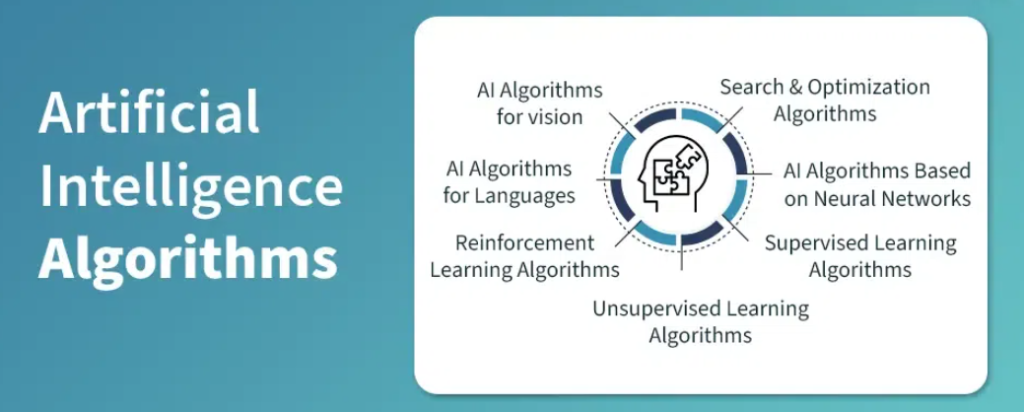
Ai Algorithms cover
1 Intuition of artificial intelligence
What is artificial intelligence?
A brief history of artificial intelligence
Problem types and problem-solving paradigms
Intuition of artificial intelligence concepts
Uses for artificial intelligence algorithms
2 Search fundamentals
What are planning and searching?
Cost of computation: The reason for smart algorithms
Problems applicable to searching algorithms
Representing state: Creating a framework to represent
problem spaces and solutions
Uninformed search: Looking blindly for solutions
Breadth-first search: Looking wide before looking deep
Depth-first search: Looking deep before looking wide
3 Intelligent search
Defining heuristics: Designing educated guesses
Informed search: Looking for solutions with guidance
Adversarial search: Looking for solutions in a
changing environment
4 Evolutionary algorithms
What is evolution?
Problems applicable to evolutionary algorithms
Genetic algorithm: Life cycle
Encoding the solution spaces
Creating a population of solutions
Measuring fitness of individuals in a population
Selecting parents based on their fitness
Reproducing individuals from parents
Populating the next generation
Configuring the parameters of a genetic algorithm
Use cases for evolutionary algorithms
5 Advanced evolutionary approaches
Evolutionary algorithm life cycle
Alternative selection strategies
Real-value encoding: Working with real numbers
Order encoding: Working with sequences
Tree encoding: Working with hierarchies
Common types of evolutionary algorithms
Glossary of evolutionary algorithm terms
More use cases for evolutionary algorithms
6 Swarm intelligence: Ants
What is swarm intelligence?
Problems applicable to ant colony optimization
Representing state: What do paths and ants look like?
The ant colony optimization algorithm life cycle
Use cases for ant colony optimization algorithms
7 Swarm intelligence: Particles
What is particle swarm optimization?
Optimization problems: A slightly more technical perspective
Problems applicable to particle swarm optimization
Representing state: What do particles look like?
Particle swarm optimization life cycle
Use cases for particle swarm optimization algorithms
8 Machine learning
What is machine learning?
Problems applicable to machine learning
A machine learning workflow
Classification with decision trees
Other popular machine learning algorithms
Use cases for machine learning algorithms
9 Artificial neural networks
What are artificial neural networks?
The Perceptron: A representation of a neuron
Defining artificial neural networks
Forward propagation: Using a trained ANN
Backpropagation: Training an ANN
Options for activation functions
Designing artificial neural networks
Artificial neural network types and use cases
10 Reinforcement learning with Q-learning
What is reinforcement learning?
Problems applicable to reinforcement learning
The life cycle of reinforcement learning
Deep learning approaches to reinforcement learning
Use cases for reinforcement learning
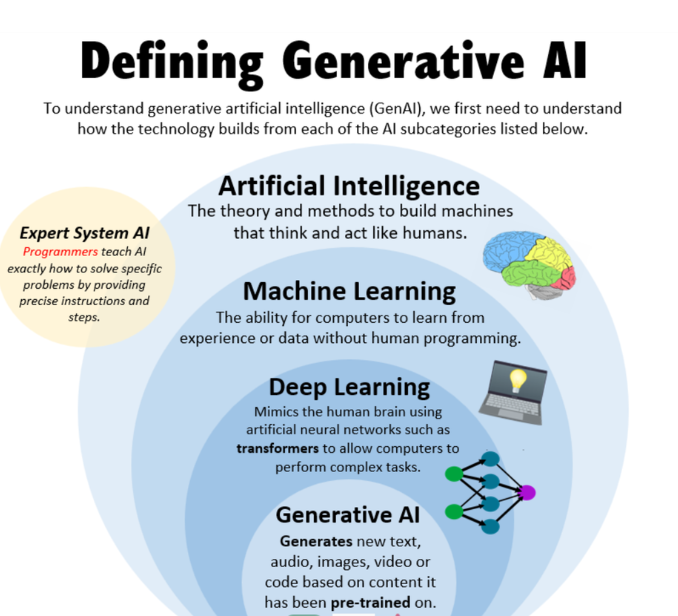
Genrative Ai cover
Chapter 1: What Is Generative AI?
Introducing generative AI
What are generative models?
Why now?
Understanding LLMs
What is a GPT?
Other LLMs
Major players
How do GPT models work?
Pre-training
Tokenization
Scaling
Conditioning
How to try out these models
What are text-to-image models?
What can AI do in other domains?
Chapter 2: LangChain for LLM Apps
Going beyond stochastic parrots What are the limitations of LLMs?
How can we mitigate LLM limitations?
What is an LLM app?
What is LangChain? Exploring key components of LangChain What are chains?
What are agents?
What is memory?
What are tools?
How does LangChain work? Comparing LangChain with other frameworks Summary
Chapter 3: Getting Started with LangChain
pip
Poetry
Conda
Docker
Exploring API model integrations Fake LLM
OpenAI
Hugging Face
Google Cloud Platform
Jina AI
Replicate
Azure
Anthropic
Exploring local models
Hugging Face Transformers
llama.cpp
Chapter 4: Building Capable Assistants 99
Mitigating hallucinations through fact-checking
Basic prompting
Prompt templates
Chain of density
Map-Reduce pipelines
Monitoring token usage
Information retrieval with tools
Building a visual interface
Exploring reasoning strategies
Chapter 5: Building a LLM APPLICATION
What is a chatbot?
Understanding retrieval and vectors
Embeddings
Vector storage
Vector indexing
Vector libraries
Vector databases
Loading and retrieving in LangChain
Document loaders
Retrievers in LangChain
kNN retriever
PubMed retriever
Custom retrievers
Implementing a chatbot
Document loader
Vector storage
Memory
Conversation buffers
Remembering conversation summaries
Storing knowledge graphs
Combining several memory mechanisms
Long-term persistence
Chapter 6: Developing Software with Generative AI
Software development and AI
Code LLMs
Writing code with LLMs
StarCoder
StarChat
Llama 2
Small local model
Automating software development
Chapter 7: LLMs for Data Science 203
The impact of generative models on data science
Automated data science
Data collection
Visualization and EDA
Preprocessing and feature extraction
AutoML
Using agents to answer data science questions
Data exploration with LLMs
Chapter 8: Customizing LLMs and Their Output
Conditioning LLMs
Methods for conditioning
Reinforcement learning with human feedback
Low-rank adaptation
Inference-time conditioning
Fine-tuning
Setup for fine-tuning
Open-source models
Commercial models
Prompt engineering
Prompt techniques
Zero-shot prompting
Few-shot learning
Chain-of-thought prompting
Self-consistency
Tree-of-thought
Chapter 9: Generative AI in Production
How to get LLM apps ready for production
Terminology
How to evaluate LLM apps
Comparing two outputs
Comparing against criteria
String and semantic comparisons
Running evaluations against datasets
How to deploy LLM apps
FastAPI web server
Ray
How to observe LLM apps
Tracking responses
Observability tools
LangSmith
PromptWatch
Chapter 10: The Future of Generative Models
The current state of generative AI Challenges
Trends in model development
Big Tech vs. small enterprises
Artificial General Intelligence
GEN AI DEVELOPER → AGENT BUILDER → JOB-READY ROADMAP
1: Core Foundation (Must-Have Skills)
This phase builds the technical thinking required to survive in AI roles.
Programming Fundamentals
Python (mandatory)
Data structures basics
OOP concepts
Functional programming mindset
Writing clean, production-ready code
Math & AI Foundations
Linear algebra (vectors, matrices – applied level)
Probability & statistics for ML
Optimization basics
Cost functions & loss functions
Overfitting vs underfitting intuition
Software Engineering Basics
Git & GitHub
APIs & REST architecture
JSON, YAML, environment variables
Debugging & logging practices
Outcome: Student starts thinking like a developer, not a tool user.
2: AI Algorithms & Machine Learning Core
This phase separates AI engineers from normal developers.
Machine Learning Algorithms
Linear & Logistic Regression
KNN, Naive Bayes
Decision Trees & Random Forest
Support Vector Machines
Clustering (K-Means, Hierarchical)
Dimensionality Reduction (PCA)
Model Lifecycle
Data collection & preprocessing
Feature engineering
Model training & validation
Evaluation metrics
Hyperparameter tuning
Hands-On Projects
AI model for student performance prediction
Recommendation system
Fraud detection mini system
Text classification engine
Outcome: Student can explain how AI works, not just use libraries.
3: Deep Learning & NLP Essentials
Now the student enters real Gen AI territory.
Deep Learning
Neural networks
Activation functions
Backpropagation
CNNs & RNNs (conceptual + applied)
Transformers architecture (high-level)
Natural Language Processing
Tokenization & embeddings
Word2Vec, GloVe
Attention mechanism
Transformers & LLM basics
Prompt engineering fundamentals
Mini Projects
Sentiment analysis engine
Chat-based FAQ bot
Resume analyzer using NLP
Outcome: Student understands how LLMs & Gen AI are built internally.
4: Generative AI & LLM Engineering
This is where job demand explodes.
Generative AI Core
LLM architecture understanding
Text, image, and multimodal Gen AI
Fine-tuning vs prompting
In-context learning
Hallucination control
Prompt Engineering (Advanced)
System, user & developer prompts
Chain-of-Thought reasoning
Prompt optimization patterns
Structured output prompts
Tool-calling prompts
LLM Integrations
OpenAI / open-source LLMs
Vector databases
Embeddings & similarity search
RAG (Retrieval Augmented Generation)
Outcome: Student becomes an LLM Engineer, not a ChatGPT user.
5: Agentic AI & MaltBot-Style Agent Systems
This is the future-proof skillset.
AI Agent Fundamentals
What is an AI agent
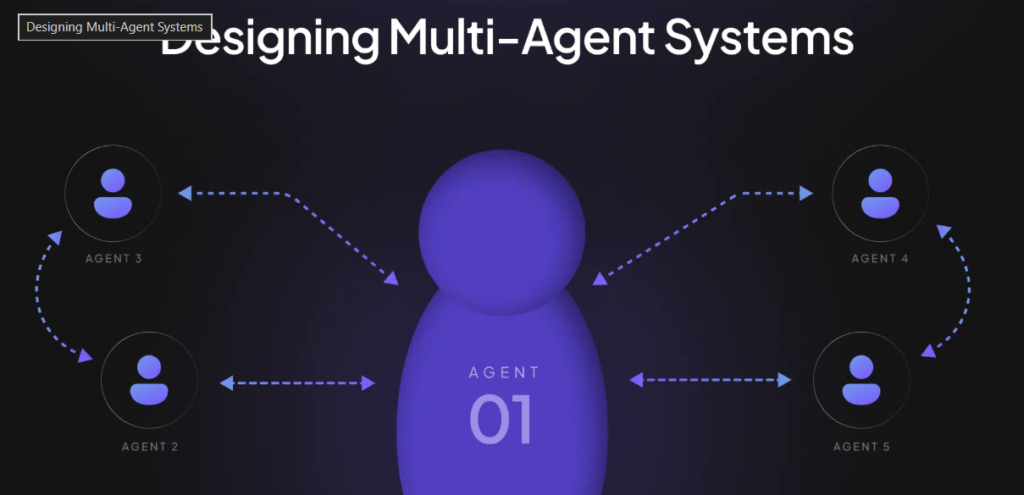
Single-agent vs multi-agent systems
Memory, tools, reasoning & planning
Agent autonomy & feedback loops
MaltBot-Like Agent Architecture
Workflow-driven agents
Trigger-based intelligence
Tool orchestration
Decision trees + LLM reasoning
Event-based execution
Agent Use Cases
AI sales agent
Customer support agent
HR screening agent
Research agent
Automation agent
Agent Projects
Build a MaltBot-style AI assistant
Multi-agent workflow system
AI business process automation
Website AI agent with memory
Outcome: Student can design and build AI agents companies actually want.
6: Full-Stack AI Product Development
Because companies hire builders, not learners.
Backend for AI Systems
FastAPI / Flask
Authentication & security
API rate limiting
Database integration
Cloud deployment basics
Frontend Basics
AI dashboards
Chat UI systems
Admin panels
Real-time updates
Deployment & Scaling
Docker basics
Cloud hosting
Model serving
Monitoring & logs
Cost optimization
Outcome: Student can ship real AI products.
7: Industry-Level Projects (Portfolio Phase)
This phase is directly aligned with internships & jobs.
Capstone Projects
AI Agent Platform (MaltBot-like)
Gen AI SaaS application
RAG-based enterprise chatbot
AI automation system for business
Multi-agent decision system
Project Standards
Clean GitHub repos
Documentation & README
Demo videos
Use-case explanation
Architecture diagrams
Outcome: Student portfolio becomes interview-ready.
8: Internship Readiness & Real-World Exposure
This phase converts skills → experience.
Internship Preparation
AI project explanation skills
Code walkthrough practice
System design interviews
Debugging live problems
Live Exposure
Working on real datasets
Client-style requirements
Team collaboration
Agile & sprint methods
Outcome: Student qualifies for AI internships & live projects.
9: Job Readiness & Placement Strategy
Final transformation into a professional Gen AI Developer.
Career Preparation
AI-focused resume building
GitHub & LinkedIn optimization
Technical interview preparation
Case-study discussions
AI system design rounds
Target Roles
Gen AI Developer
AI Engineer
LLM Engineer
AI Agent Developer
AI Automation Engineer
Outcome: Student is job-ready with confidence.
Final Transform
By completing this , a student becomes:
✔ Strong in AI algorithms
✔ Expert in Generative AI & LLMs
✔ Skilled in MaltBot-style AI agents
✔ Capable of building production AI systems
✔ Ready for internships, startups, and MNC roles